Catholic doctrine on suicide and ownership of the body
Elena KnowsCatholic doctrine on suicide and ownership of the body treats life and the body as belonging to God, not as possessions over which individuals have final authority. In the novel, Father Juan applies that principle to Rita’s death and groups suicide with murder, abortion, and euthanasia as forms of wrongful use of the body. Elena disputes the authority behind that judgment: she insists that the truth about her daughter’s death cannot be settled by doctrine alone, and that her own failing body is already beyond her control. The conflict makes religious teaching an active force in questions of death, care, and who may decide how a person lives or dies.
The Doctrine and Father Juan’s Judgment
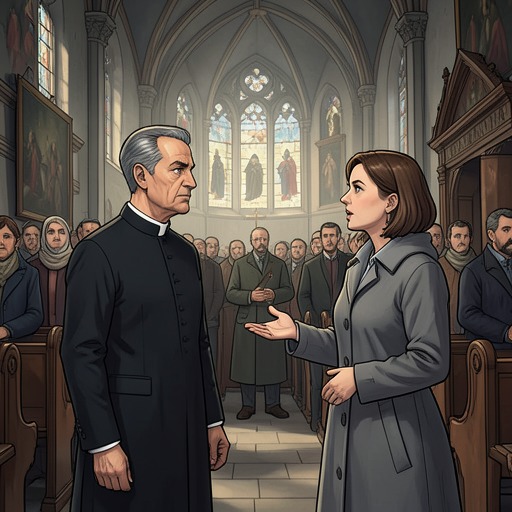
Father Juan explains the doctrine to Elena while she is seeking an account of how Rita came to die in the church bell tower. He frames the body as belonging to God and human beings as having only the right to use it. On that basis, he says the Catholic Church condemns suicide just as it condemns murder, abortion, and euthanasia. He calls Rita’s death an aberrant act and interprets it as the deliberate waste of a body that was not hers to dispose of. In his account, Christian belief also means accepting that people do not decide when their lives should end.
His explanation does not answer Elena’s central question about the circumstances of Rita’s death. Elena repeatedly returns to the rain, which she believes matters because Rita was afraid of being struck by lightning and avoided church on rainy days. Father Juan treats this emphasis as pride: he accuses Elena of assuming she knows more than the facts allow. Their disagreement is therefore not only about whether suicide violates religious teaching. It is also about what counts as knowledge, whether a mother’s attention to her daughter’s habits should be taken seriously, and whether a religious authority can declare the meaning of a death before its circumstances have been fully understood.
The circumstances of the discovery sharpen that tension. Boys assigned by Father Juan to ring the bells found Rita dead in the belfry. Although he recognized her, he did not say her name at first; he checked for a pulse, then called the police. He asked the inspector not to delay the seven o’clock service, held on Corpus Christi, because parishioners were already arriving and, in his view, nothing more could be done for Rita except pray. The mass went ahead while her body remained above the congregation. The contrast between the continuing ritual and Elena’s unanswered questions shows how religious practice can contain a death without resolving what it means to those left behind.
Elena’s Challenge: Illness, Use, and Authority
Elena answers Father Juan’s account by turning its language toward her own experience. She argues that she has not had the use of her body for some time, and that Parkinson’s disease, not God, has taken that capacity from her. Her objection exposes a gap in the doctrine as Father Juan presents it: the claim that the body is entrusted to a person does not describe what it is like when illness steadily limits movement and ordinary action. Elena refuses to let religious language convert that loss into evidence of faith or into a reason she must accept someone else’s explanation of death.
Father Juan urges her to pray for Rita’s soul and to remain constant in faith. Elena rejects both the assumption that she believes and the idea that spiritual judgment is the answer she came to seek. She asks for judgment on earth and wants help uncovering the truth. When the priest repeats that Rita chose to end her life, Elena challenges the Church’s authority to claim the word of God as its own. The encounter ends with her leaving, physically struggling to cross the doorway and refusing Father Juan’s attempt to name her identity for her. His insistence that she remains a mother does not settle what that identity means to Elena; she maintains her right to decide how she behaves, lives, or dies.
Faith as Practice, Not Simple Certainty
Elena’s conflict with Father Juan sits alongside a more complicated history of belief within her family. Her husband, Antonio, was a practicing Catholic, and Elena concealed her disbelief in the soul and eternal life because she expected him not to understand. She later recalls that Father Juan had called people foolish for regarding death as final. Religious language remained familiar to her even without religious conviction: prayers, the Creed, sin, and resurrection continued to occupy her thoughts.
Rita’s observance, in Elena’s recollection, was neither full conformity nor simple rejection. She wore a cross and followed many customs: visiting seven churches on Good Friday, fasting during Lent, arriving at mass before the Creed, and making the sign of the cross when passing a church. Yet she might skip mass when it rained, did not confess every sin, and sometimes said that God did not deserve her praise. Elena understands this as Rita assembling a personal religion from ritual and tradition rather than submitting consistently to doctrine. That distinction matters to the dispute over Rita’s death: religious signs in her life do not establish what she believed about suicide or explain her final actions.
Bodily Autonomy and the Limits of Care
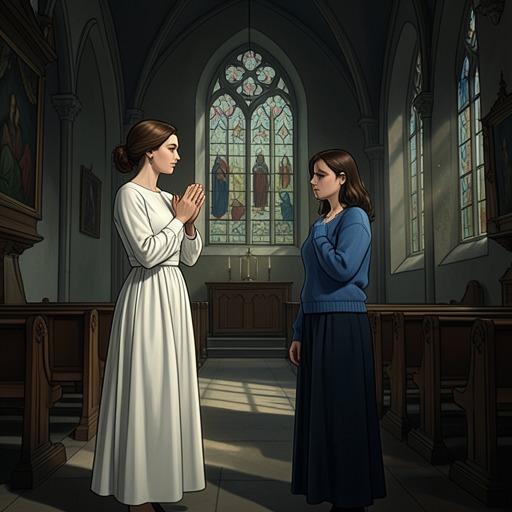
The doctrine’s application reaches beyond Father Juan’s conversation with Elena. Twenty years earlier, Rita encountered Isabel while Isabel was sick and seeking to end a pregnancy. Rita argued that abortion was a mortal sin, appealed to the life she believed Isabel carried, and invoked God’s will and the claim that a child could not exist without a mother. Isabel said she did not want to be a mother and challenged Rita’s assumption that the decision belonged to someone else. The episode shows religious arguments about the body operating not only as judgments after death but also as pressure on a living person’s reproductive decision. Rita’s appeal to faith and motherhood is part of her intervention, but the scene also makes clear that Isabel contests the authority to define her choice for her.
The novel places these conflicts beside the practical demands of Elena’s illness. Doctors diagnose her with Parkinson-Plus and warn that her condition will progress, requiring increasing assistance. Rita confronts the prospect of becoming her mother’s caregiver and protests the amount of dependence the illness will impose. The resulting burden is not resolved by the religious claim that a body belongs to God: Elena still faces the material consequences of bodily decline, while Rita faces the work of care. Meanwhile, obtaining disability certification requires them to navigate extensive paperwork before a doctor finally documents Elena’s condition. That process gives formal recognition to a disability that was already evident, underscoring the difference between a principle about the body and the institutions and relationships that determine how bodily needs are met.
Across these situations, the doctrine supplies a powerful vocabulary for judging acts involving life and the body, but it does not produce a single shared understanding of responsibility. Father Juan uses it to condemn suicide and direct Elena toward prayer; Elena challenges its authority over her body and over the truth of Rita’s death; Rita invokes religious belief in an attempt to prevent Isabel from ending a pregnancy. The same moral framework thus appears as doctrine, personal practice, and interpersonal pressure. Its significance lies in that conflict: the body may be declared God’s property, yet illness, reproductive choice, and caregiving expose how intensely its use and care are contested among the people who live with its consequences.